


Early Warning & Governance Monitoring "Enhancing Informed Decision-Making"



Agenda 2030
Goal 16: Promote peaceful and inclusive societies for sustainable development, provide access to justice for all and build effective, accountable and inclusive institutions at all levels
Agenda 2063
Aspiration 3: An Africa of good governance, democracy, respect for human rights, justice and the rule of law
Aspiration 4: A peaceful and secure Africa
The Continental Early Warning System (CEWS) is one of the five pillars of the African Peace and Security Architecture (APSA).
It aims to monitor and provide data-driven analyses of African governance, political, and security developments.
This information is used to inform decision-making and interventions by the Peace and Security Council (PSC)
and the AU leadership to support member states in their pursuit of peace, security, and stability.
Early Warning Systems (EWS) are established both on the continental and regional levels.
The Continental Early Warning system (CEWS) at Union level, regional early warning systems of the
Intergovernmental Authority for Development (IGAD: CEWARN), the Economic Community of
West African States (ECOWAS: ECOWARN), the East African Community (EAC: EACWARN), the
Common Market for Eastern and Southern Africa (COMESA: COMWARN), the Economic Community of Central African States (ECCAS: MARAC).
The Southern African Development Community (SADC) early warning system is intelligence based.
The early warning systems have been established to provide
decision makers at continental level and at regional level with timely information, analysis and response options.
PAPS Commissioner: Amb. Bankole Adeoye, Nigeria (elected in February 2021) Governance and Conflict Prevention - Director: Patience Zanelie Chiradza, Zimbabwe CMD - Director: Dr. Sarjoh Bah @AUC_PAPS Hashtags: #CEWS #earlywarning #APSA #silencingtheguns #NeTT4Peace #I-RECKE
"Conflict prevention through early warning and timely response remains the most efficient and cost-effective approach to sustainable peace, security and stability on the continent." Amb. Bankole
About
Enhancing Informed Decision-Making
Introduction and Background:
- 2002: Transformation of the OAU to the AU;
- Article 3(f) of the Constitutive Act: the core objectives of the AU is the promotion of peace, security, and stability on the continent;
- July 2002: the “Protocol Relating to the Establishment of the Peace and Security Council (PSC) of the AU”, which entered into force in December 2003 and which was solemnly launched on 25 May 2004;
- Article 2 (1) of the PSC Protocol defines the PSC as “a collective security and early-warning arrangement to facilitate timely and efficient response to conflict and crisis situations in Africa”.
- July 2003: the Heads of State and Government mandated the AU Commission to take the necessary steps for the establishment of the CEWS;
- July 2005: based on the series of recommendations obtained from consultations and workshops, the Commission developed a draft Roadmap for the Operationalization of the CEWS;
- June 2006: the PSC requested the AU Commission to hasten the operationalization of the continental peace and security architecture, including the CEWS;
- The Commission then intensified its efforts to prepare the relevant technical documentation in support of the draft Roadmap for consideration by representatives of Member States, RECs and other partners. In addition to an updated version of the draft Roadmap itself (Issue Paper 1), the Commission prepared two issue papers of a technical nature (on the Indicators Module and on the Participation of Civil Society) and three background papers (on Development of IT Technology, on Conceptual and Methodological Issues in the Development of Early Warning Indicators, and on Status of Implementation of Early Warning Systems in the RECs/RMs).
- December 2006: the Commission convened a meeting of Governmental Experts on early warning and conflict prevention, bringing together experts from AU Member States and representatives of the RECs/RMs;
- January 2007: The Executive Council endorsed the “Framework for the Operationalization of the Continental Early Warning System”;
- 2008: the MoU between AUC and RECs/RMs was signed.
CEWS’ Legal Provision and Rationale
- The establishment of the CEWS is a requisite of the PSC Protocol as detailed in Article 12 (1) which states that, “in order to facilitate the anticipation and prevention of conflicts, a Continental Early Warning System to be known as the Early Warning System shall be established“;
- The PSC Protocol notes that the information and analysis gathered through the EWS shall be used by the Chairperson of the Commission to “advise the PSC on potential threats to peace and security in Africa and recommend the best course of action“ [Article 12 (5)];
- The establishment of the CEWS is a requisite of the PSC Protocol as detailed in Article 12 (1) which states that, “in order to facilitate the anticipation and prevention of conflicts, a Continental Early Warning System to be known as the Early Warning System shall be established“;
- The PSC Protocol notes that the information and analysis gathered through the EWS shall be used by the Chairperson of the Commission to “advise the PSC on potential threats to peace and security in Africa and recommend the best course of action“ [Article 12 (5)];
"The PSC in its press statement of its 527th session stated: Council noted with concern, the gap that exists between early warning and early response and reiterated the importance of strengthening the linkages between early warning and early response, which requires that the relevant AU structures act effectively on early warning information provided to them regarding potential conflicts and crises. In this regard Council stressed the imperative need of receiving regular early warning reports/briefings to enable it to take appropriate action.’"The significance, centrality and success of early warning in the prevention and resolution of conflicts either at structural and or operational levels through good offices, preventive diplomacy and mediation etc. cannot be overemphasized and often hinges on the influence and convening power of the AU as an institution. Having a more robust engagement on the ground, building relationships with key political stakeholders and visibly popularizing the AU and the PSC as mechanisms available to support conflict prevention and resolution through field engagements, enhanced communication, financial and technical support to Member States for early warning and conflict prevention and other outreach strategies can serve as concrete entry points for the AU’s follow up in conflict and post-conflict environments. However, to make the impact of these engagements more viable, it is necessary to ensure adequate, tangible follow-up and sustained robust interaction. They should not be once-off activities but rather part of a broader, long term engagement plan of the Commission in strong collaboration with RECs/RMs.
Methodology
Enhancing Informed Decision-Making
Methodology
CEWS Analytic Framework
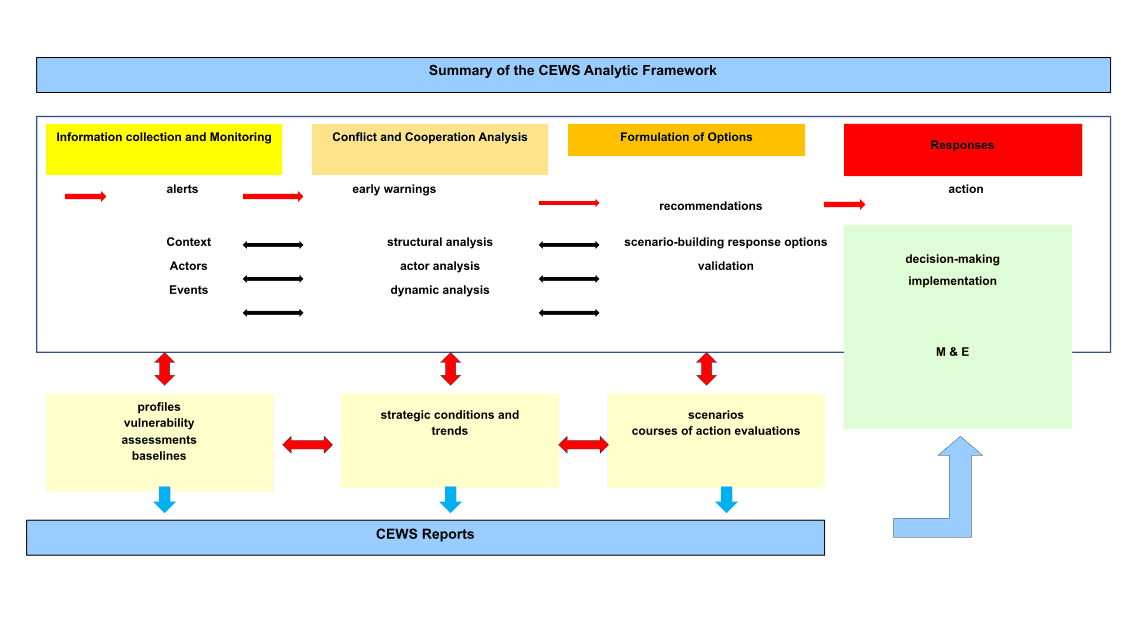
- Sources - Information is gathered from a variety of sources, including – Governmental and Inter-Governmental actors, international and non-governmental organizations, CSOs, media, academia and think-tanks
- Information management - Efficient management of data and information must include adequate collection, compilation, management and distribution systems
- Indicators - Development of indicators to facilitates the establishment of parameters for the type of information to be gathered
- Clusters of information – - Context and Structural information on countries and Regions; - Actor attribute information on key individuals and groups -Information on events as they evolve over time
- Structural Analysis – to identify the root causes of the conflict and develop vulnerability/risk assessments
- Actor Analysis – To identify the main protagonists who influence or are affected by a situation Interests, incentives and networks of individuals, groups and institutions
- Dynamic Analysis – to look at the aggravators, triggers, proximate causes and inhibitors of a conflict and track the trends
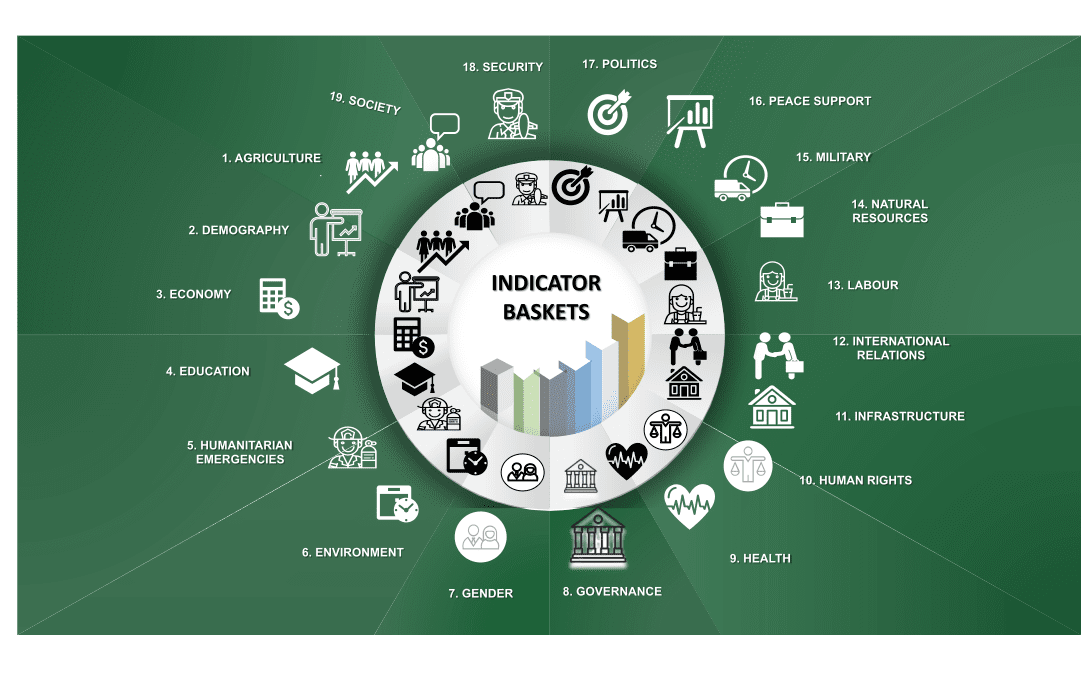
• In order to analyze developments and recommend appropriate courses of action, the CEWS shall “develop an early warning module based on clearly defined and accepted political, economic, social, military and humanitarian indicators” [Article 12 (4)];
• Article 12 (3) of the PSC Protocol requires the AU Commission to “collaborate with the United Nations and its agencies, other relevant international organizations, research centers, academic institutions and Non-Governmental Organizations (NGOs)“;
CEWS Top Level Indicator Baskets
- The AU-PAPS Situation Room
- Regional/Country Analysts
- The observation and monitoring centers of the RECs/RMs
- Engagement with decision makers
- Coordination and collaboration with other stake holders
- Engagement with Decision Makers through the different early warning products.
- Structural Vulnerability Assessments (SVAs): an annual desk research conducted to forecast the level of vulnerability of countries to conflict and explaining their associated drivers.
- Country Structural Vulnerability and Resilience Assessment (CSVRA) and the resultant Country Structural Vulnerability Mitigation Strategy (CSVMS): Member state self-assessment mechanisms to identify country specific resiliencies and vulnerabilities to propose and support the implementation of mitigation strategies.
- Support to build Member States’ National Infrastructure for Peace: building member state capacities to facilitate timely early warning and early response.
- Regular Horizon Scanning Briefings to the PSC.
- Coordination and Collaboration with different stakeholders.
Early Warning Tools
Africa Media Monitor (AMM)Provision of systematic data gathering from the open sources
Africa Reporter Provision of systematic data collection using field monitors
Africa ProspectsFor conducting Structural Vulnerability Assessments
Event Detection, Extraction and Moderation systemExtracting structured data from unstructured open source articles
Conflict Alerting and Analysis System (under development) Provision of a unified dashboard in support of unified analysis
Third party software: Tableau and StataFor the provision of business intelligence through visualizations and models as well as Senturion for stakeholder analysis for mediation support.
Major Initiatives
Deliver as One.
The significance, centrality and success of early warning in the prevention and resolution of conflicts either at structural and or operational levels through good offices, preventive diplomacy and mediation etc. cannot be overemphasized and often hinges on the influence and convening power of the AU as an institution. Having a more robust engagement on the ground, building relationships with key political stakeholders and visibly popularizing the AU and the PSC as mechanisms available to support conflict prevention and resolution through field engagements, enhanced communication, financial and technical support to Member States for early warning and conflict prevention and other outreach strategies can serve as concrete entry points for the AU’s follow up in conflict and post-conflict environments. However, to make the impact of these engagements more viable, it is necessary to ensure adequate, tangible follow-up and sustained robust interaction. They should not be once-off activities but rather part of a broader, long term engagement plan of the Commission in strong collaboration with RECs/RMs.
Operational conflict prevention efforts
- CEWS Situation Room and Analysts
- PoW
- FEM-WISE
Structural conflict prevention initiatives
- Normative and legal instruments
- SVAs
- Continental Structural Conflict Prevention Framework (CSCPF) (CSVRA and CSVMS)
- AU Borders Programme
- National Infrastructures for Peace ( including National Early Warning Systems)
- Support to Regional Economic Communities (RECs)
- Regional Peace and Security Strategies
- Election Observations
- CSO Engagement (Data collection and thematic research)
Thematic prevention of conflict
- Human Rights
- Atrocity Crimes
- Election Situation Project
- Youth for Peace
- Climate Change
- Transhumance
Footprint of Success
2010s
1.10
- Milestones 1.10
- Milestones 1.10
- Milestones 1.10
- Milestones 1.10
- Milestones 1.10
- Milestones 1.10
- Milestones 1.10
2010s
1.11
- Milestones 1.11
- Milestones 1.11
- Milestones 1.11
- Milestones 1.11
- Milestones 1.11
- Milestones 1.11
- Milestones 1.11
2010s
1.12
- Milestones 1.12
- Milestones 1.12
- Milestones 1.12
- Milestones 1.12
- Milestones 1.12
- Milestones 1.12
- Milestones 1.12
- 1
2010s
1.21
- Milestones 1.21
- Milestones 1.21
- Milestones 1.21
- Milestones 1.21
- Milestones 1.21
- Milestones 1.21
- Milestones 1.21
2010s
1.22
- Milestones 1.22
- Milestones 1.22
- Milestones 1.22
- Milestones 1.22
- Milestones 1.22
- Milestones 1.22
- Milestones 1.22
- In line with Article 12 of the PSC Protocol, which provides for the anticipation and prevention of conflicts in Africa through the establishment of CEWS, the regional desks for early warning and governance monitoring continued to provide regular analytical reports on emerging and existing threats to human security, peace and stability to inform early response to conflicts and crisis situations in Africa.
- In collaboration with RECs/RMs, the Commission advanced the implementation of the Continental Structural Conflict Prevention Framework (CSCPF) and provided financial, technical and logistical support to Member States on structural conflict prevention efforts through the establishment and or strengthening of peace infrastructures; and conduct of Country Structural Vulnerability and Resilience Assessment and its corresponding Country Structural Vulnerability Mitigation Strategy (CSVRA/CSVMS).
- In order to garner enhance the implementation of CSVRA/CSVMS processes, which is essential to identifying structural causes of conflicts, resilience as well as mitigation strategies to transform the vulnerabilities and strengthen resilience, the Commission, RECs/RMs and APRM developed proposed strategies to intensify popularization and assessment of the CSVRA as well as implementation, monitoring and evaluation of the CSVMS processes respectively.
- The proposals, which were presented at the joint APRM and PSC retreat in November 2021 shall be submitted to the PSC for consideration and necessary action.
- Specifically, in collaboration with ECOWAS Commission, CEWS facilitated a benchmarking mission for a Ministerial delegation from the Republic of Côte d'Ivoire to the Republic of Ghana from 17 to 20 November 2021.
- The Commission's support facilitated lessons on the best practices, challenges and opportunities of Ghana's National Peace Council to inform replication of the same model or guide the strengthening of existing peace infrastructures in Côte d'Ivoire.
- Further, in collaboration with relevant RECs, the Commission also facilitated the conduct of national and regional consultations as part of the CSVRA process in the Republic of Côte d'Ivoire in June/July 2021 and in the Republic of Zambia in October/November 2021 respectively.
- The Commission further provided technical support to the Republic of Ghana towards identifying and prioritizing of mitigation strategies highlighted in the CSVRA/CSVMS report to be implemented in the short, medium to long term.
- As part of efforts to re-energize early warning and conflict prevention efforts, which is a strategic priority of PAPS Department, an Inter-regional Knowledge Exchange Platform (I-RECK) has been developed by the Department to facilitate experience sharing and lessons learned on best practices and opportunities for early warning and conflict prevention.
- The strategic objectives of the knowledge exchange platform include:
- to re-energize early warning systems, preventive diplomacy and mediation as well as to mainstream governance in conflict prevention activities;
- to strengthening Democracy, Good Governance and Conflict Prevention through the institutionalization of the nexus between AGA and APSA; to re-invigorate relations between Member states, AUC and the RECs/RMs and relevant organs, institutions and actors to build synergies for the implementation of policies and programs at regional and continental levels;
- and for improved knowledge sharing and exchange;
- and improved cross-regional learning of best practices and resilience building at regional and continental levels.
- Furthermore, in order to facilitate strategic information sharing and cooperation, the Commission had facilitated and convened meetings between regional security mechanisms under the auspices of the Djibouti and Nouakchott processes, which served the Horn of Africa as well as West Africa and the Sahel respectively.
- However, due to COVID-19 induced travel related as well as budgetary constraints, the process as stalled as the sensitive nature of the engagements require physical meetings.
PSC
- Similarly, from 14 to 15 November 2022, the PSC held the Second Joint Retreat with APRM, in line with the conclusions of the Inaugural Joint retreat held in December 2021. During the 2nd Joint Retreat, the two sides took stock of the status of implementation of the conclusions of the Inaugural Joint Retreat and received several briefings on the Peer Review Reports of the various AU Member States. It was stressed that issues of governance, peace and security are becoming complex and therefore, the need was underscored for the APRM to intensify its efforts in conflict prevention through closer coordination with the Panel of the Wise, as well as the full utilization of I-RECKE which provides a platform to engage the RECs/RMs on early warning and early response.
- Additionally, the PSC invited a number of AU Organs and security related institutions to share updates. The Council was briefed by CISSA, ACSRT, AFRIPOL on early warning and continental security outlook, including terrorism and violent extremism. Thus, the PSC emphasized the essence of enhancing collaboration with AU Organs/institutions on early warning and intelligence sharing with a view to supporting Member States and RECs/RMs in addressing peace and security challenges facing the Continent.
- In a quest to prevent the situation in Guinea-Bissau from escalating any further, the AU deployed its efforts on conflict prevention, promotion of good governance, and early warning.
Protection of Children in Situations of Conflict
- In furtherance of accountability, the CiSC programme started processes towards the implementation of a key decision of the AU Assembly, Assembly/AU/Dec.718 (XXXII), whereby the Assembly requested the AUC to establish a continental reporting and monitoring framework to provide the AU with accurate, reliable and up-to-date data on the plight of children in situations of violent conflict and crisis. A technical working session with child protection, early warning , reporting and monitoring experts was convened which resulted in the development of a framework for the establishment of a Continental Monitoring, Reporting and Accountability Mechanism on the Status of Children in Situations of Conflict. Of note was the recommendation to undertake an empirical study to build on the 1996 Graca Machel study on the impact of conflicts on children. The study will identify existing gaps, emerging violations, institutional mechanisms that the continental mechanism can hinge on and other operational modalities.
PAPS capacity building to mainstream gender in activities and programme
- In accordance with the PSC communiqué adopted at its 407th meeting held on 4 December 2013 (PSC/PR/BR/CDVII), which stressed the need to develop African capacity, the PAPS Department embarked on the development of tailored capacity building tools including an operational guidance note (OGN) on gender mainstreaming in early warning mechanisms (EWM) to promote the application of gender sensitive approaches in early warning data collection, analysis and formulation of response options in AU and RECs/RMs. Others are a toolkit for women human rights defenders' engagement with the African human rights systems to provide technical guideline for Women Networks on how to interact with the African human rights system; and an online course on gender sensitive conflict analysis to strengthen the effectiveness of conflict prevention frameworks, tools, methodologies, and processes and provide material and practical strategies to guide the development of gender-responsive conflict analysis in all stages of conflict.
Climate Change, Peace and Security
- Climate change undermines human security and further exacerbates the factors that affects national security. It is within this context that PAPS, based on mandates given by the AU PSC and the Assembly of Heads of State and Government, initiated measures to develop a common African position on the nexus between climate change, peace and security to deepen knowledge and understanding of the linkages between the impact of climate change, on peace and security. Key Messages were generated and presented to the AU PSC on 2 November 2022, and at COP 27 on 8 November 2022. The Department also initiated a process to review the early warning indicators and mainstream climate change factors for information gathering and data analysis towards effective preventive measures and responses.
Launch and Operations of AU Inter-Regional Knowledge Exchange (I- RECKE) on Early Warning and Conflict
- The AU Inter-Regional Knowledge Exchange (I-RECKE) on Early Warning and Conflict Prevention was co-created by the AU and RECs/RMs as a Pan-African initiative, to advance information and knowledge exchange, as well as co-learning on generating early action to prevent and respond effectively to conflicts. The AUC facilitated the pre-launch and official launch of I-RECKE at the 4th Mid-Year Coordination Meeting in Lusaka in July 2022.
Operationalization of the AU Peace Fund
- The AUC in 2022, under the auspices of the Chairperson, continued to work towards the operationalisation of the revitalized AU Peace Fund in fulfilment of the AU's commitment to promote African ownership and leadership by contributing substantially to financing its own agenda for peace, security and stability, in compliance with relevant Assembly Decisions. The full operationalisation of the AU Peace Fund, in addition to providing a political signal that Africa is committed to improving on its self-reliance targets, will provide the Commission with the capacity to operationalise its early response mechanism , which further helps bridge the gap between early warning and early response .
2023
- The initiatives undertaken by the Commission in this area show a direct and purposeful connection to the overarching goal of conflict prevention on the continent. In democratic governance, strategic emphasis is placed on enhancing coordination among member states, as facilitated through mechanisms like the African Governance Platform. This collaborative approach aims to build consensus and promote dialogue among diverse stakeholders, mitigating potential sources of conflict that may arise from political volatility and electoral processes. Notably, initiatives like the High-Level Dialogue on Democracy serve as proactive measures to foster discourse, reducing the likelihood of disputes and contributing to the maintenance of stability.
- Simultaneously, endeavors in democratic and public sector governance can contribute to conflict prevention by advocating novel methodologies and promoting good governance practices. Processes such as election observation and monitoring, technical assistance to member states, and events such as Africa Public Service Day align with Agenda 2063 objectives, emphasizing the importance of effective governance in reducing socio-political tensions. The prioritization of human rights through initiatives like the African Union Business and Human Rights Policy and the Africa Regional Consultation on the Right to Development ensures that fundamental principles are integrated into corporate settings, contributing to a more equitable and just socio-economic landscape. This, in turn, addresses potential sources of social unrest and conflict.
2023 (continued)
- Furthermore, the support to member states in transitional justice programs and the initiative for African Women for Transitional Justice reflects a commitment to addressing historical grievances and fostering national cohesion, critical elements in conflict prevention. Within security sector governance, the AU's comprehensive initiatives, including disarmament, small arms control, and post-conflict reconstruction, directly contribute to preventing the emergence or resurgence of conflicts by addressing key factors that fuel violence.
- Therefore, the analytical coherence of these initiatives not only underscores the AU's dedication to conflict prevention but also emphasizes the need for nuanced, multi-faceted approaches to tackle the continent's complex challenges. By addressing root causes, promoting dialogue, and establishing frameworks for justice and good governance, the Commission's initiatives actively create conditions that deter the escalation of tensions and contribute to sustained peace and stability across the African continent.
2024
- In partnership with the RECs/RMs and APRM, the AU Commission advanced the implementation of the Continental Structural Conflict Prevention Framework (CSCPF). In this regard, the Commission provided financial and technical support to Member States in 2024 for structural conflict prevention efforts through the establishment and strengthening of national peace infrastructures and the conduct of the Country Structural Vulnerability and Resilience Assessment (CSVRA) and its corresponding Country Structural Vulnerability Mitigation Strategy (CSVMS).
- In 2024, significant progress was made in advancing the implementation of the Continental Structural Conflict Prevention Framework (CSCPF) through financial and technical support to Member States. In National Peace Infrastructures (NPI), the establishment and strengthening of national peace infrastructures were supported in Ethiopia, Sierra Leone, Ghana, Zambia, and Benin. On CSVRA processes support was provided Zambia and Malawi. The AU, in partnership with COMESA, facilitated virtual consultations with Seychelles to advance the CSVRA. Also in partnership with COMESA, multi-stakeholder consultations were conducted in Rwanda and Burundi, contributing to the CSVRA process. A planning meeting in Kenya was held as part of the CSVRA initiative.
2024 (continued)
- The PSC, in its Communique 1163 of July 21, 2023, encouraged Member States to “fully embrace the Continental conflict prevention frameworks, which include the voluntary CSVRA and CSVMS.” In 2024 support zeroed in on two (2) new Member States, namely, Malawi and Kenya, as they embarked on their self-assessment through the CSVRA/CSVMS processes. With this, five (5) AU Member States have now acceded to the CSVRA/CSVMS processes. This follows the pace-setting roles of Ghana, Cote d’Ivoire, and Zambia.
- Specifically, in collaboration with COMESA, the Commission, in 2024, supported Zambia in validating the CSVRA/CSVMS report; supported Malawi and Kenya in developing a comprehensive roadmap for the implementation of the CSVRA/CSVMS processes; and facilitated multi-stakeholder consultations in Rwanda, Burundi and Seychelles.


