

 comments
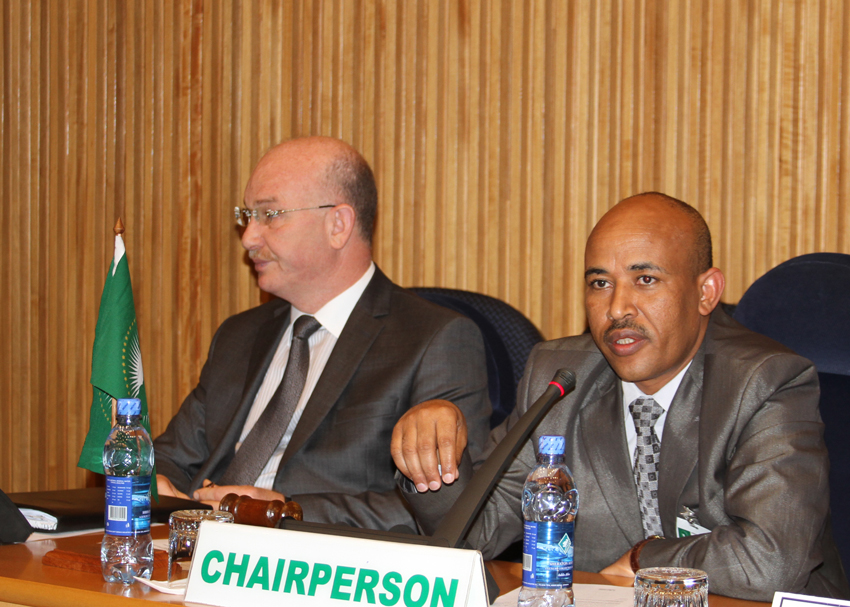
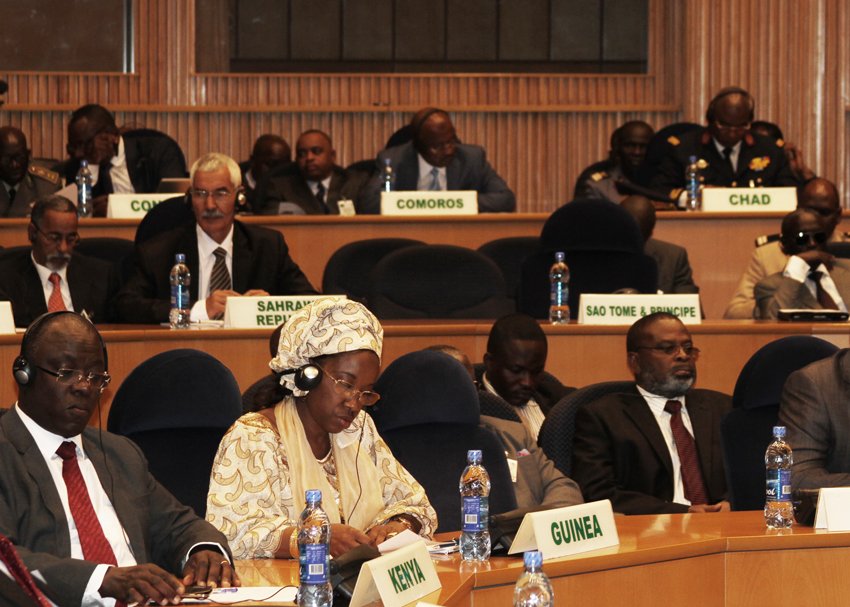
7TH MEETING OF THE SPECIALIZED TECHNICAL
COMMITTEE ON DEFENSE, SAFETY AND SECURITY
ADDIS ABABA, 14 JANUARY 2014
Honourable Ministers and other Heads of Delegation,
Chiefs of Defense Staff and Heads of Safety and Security Services,
Ladies and Gentlemen,
As the new African Union Commissioner for Peace and Security, I am pleased to address this 7th meeting of the Specialized Technical Committee on Defense, Safety and Security. Your gathering, which is taking place two weeks before the ordinary sessions of the African Union policy making organs, is expected to make recommendations on how best to take forward our common endeavor to operationalize the African Standby Force, including its Rapid Deployment Capability, by 2015, and, in the meantime, the African Capacity for Immediate Response to Crises, to enable the continent effectively respond to urgent peace and security challenges. These recommendations will inform the decisions to be taken by the Summit.
On behalf of the Chairperson of the Commission, Dr. Nkosazana Dlamini-Zuma, and on my own behalf, I would like to wish you and your loved ones a happy New Year. It is our sincere hope that, thanks to our collective efforts and commitment, the continent will make further progress in its quest for lasting peace, security and stability, so as to create a more conducive environment for the advancement of our people and the fulfillment of their long cherished dream of well-being.
I welcome you all to Addis Ababa, and to our Headquarters. Knowing your busy schedule and competing obligations, I am very delighted to see you all here.
As we gather today, we cannot but pay tribute to the African and non-African military and police personnel deployed in peace support operations across the continent. Operating in often very challenging circumstances, they have continued to display courage and commitment. A number of them have fallen in the line of duty. We owe them eternal gratitude for their sacrifice.
Honourable Ministers and other Heads of Delegation,
Ladies and Gentlemen,
As you all would recall, at your sixth meeting, in April last year, you recommended that the Commission conducts a comprehensive assessment of the African Standby Force, including its Rapid Deployment Capability, and present a report to your next meeting. The request you made was informed by a sense of urgency and the need to ensure that this important pillar of our Peace and Security Architecture is indeed fully operational by 2015.
At its May 2013 ordinary session, the Assembly of Heads of State and Government, having recalled the report that the Chairperson of the Commission submitted to the April meeting of the Specialized Committee, as well as the Declaration adopted on that occasion, decided, in principle, to immediately establish an African Capacity for Immediate Response to Crises. Conceived as a transitional arrangement, pending the full operationalization of the African Standby Force and its Rapid Deployment Capability, this Capacity is intended to provide the AU with a flexible and robust force to be deployed very rapidly in response to emergency situations, within the framework of the African Peace and Security Architecture.
The Assembly further requested Member States willing and ready to immediately contribute military and police capabilities, as well as equipment and financial resources, to notify the Commission. It also requested the Chairperson of the Union and the Chairperson of the Commission to undertake appropriate consultations to build the broadest possible support and adherence to the implementation of the decision to establish the Capacity.
In making this decision, the Assembly was guided by the need to ensure that Africa is in a better position to respond to the peace and security challenges facing her. In particular, the Assembly had in mind the situation in Mali. While our continent, in particular through ECOWAS and Chad, displayed a high level of solidarity and support to this brotherly country, there is no doubt that our response could have been more effective. As a result of our own constraints, we had to rely on the French Operation Serval to counter the offensive that had been launched by the armed and terrorist groups in January 2013. The Heads of State and Government, while appreciative of that timely support, felt, and rightly so, that Africa, through its continental Union and Regional Mechanisms, should have played the leadership role.
In a nutshell, this is the background against which your meeting is being held. I have no doubt that your recommendations will meet the expectations of our leaders.
Honourable Ministers and other Heads of Delegation,
Ladies and Gentlemen,
I am pleased to report that, pursuant to these decisions, the Commission has undertaken the required follow-up steps, driven as we were by our commitment to do whatever is possible to facilitate your deliberations.
Regarding the assessment of the African Standby Force, the Commission put in place a Panel of Independent Experts to undertake this task. We chose one of Africa's most experienced and distinguished diplomats, Professor Ibrahim Gambari, to lead the team, which also included a number of experts. Allow me, at this juncture, to commend Prof. Gambari and his colleagues in the Panel, for the dedication and professionalism with which they discharged their mission.
The Panel's Report is before you. It has been thoroughly considered by both the meeting of experts held on 10 January and that of the Chiefs of Defense Staff, which took place two days ago. The recommendations made, some of which are in actual fact a reaffirmation of earlier ideas, have been well received and endorsed with minor adjustments. The report provides a roadmap on what both the Member States and the Commission need to do to ensure that the African Standby Force attains its full operational capability by 2015, as planned.
There is no need for me to dwell much on the recommendations of the Panel. Suffice for me to stress that the attainment of full operational capability would require renewed efforts by member states and the regional standby brigades.
As you are all aware, the African Standby Force was initially intended to be operational in 2010. But owing to the delays encountered, this deadline was pushed to 2015. It goes without saying that we simply cannot afford another postponement, otherwise the credibility of our collective undertaking will be eroded.
Building on the progress made, we ought to do more in the next two years. In concrete terms, this means greater focus, dedication and necessary resources. The African Standby Force cannot continue to be a synonym of an endless process, punctuated by workshops and studies. It cannot continue to be the subject of successive road maps that never come to complete fruition. It cannot continue to be a dream always deferred. We have to be action-oriented. We have to live up to the expectations we have raised by setting a deadline. Failure is not an option. I would like to assure you that the Commission will as always fully play its role and lend the necessary support.
Allow me now to turn to the African Capacity for Immediate Response to Crises. Let me start by saying that, based on the Assembly's decision I alluded to earlier, in mid-June 2013, the Chairperson of the Commission wrote to all the Heads of State and Government to formally request willing nations to contribute personnel and resources, both logistical and financial, to the Capacity. A number of countries have since made pledges in support of the Capacity. These are Algeria, Angola, Chad, Liberia, Niger, Senegal, Sudan, Tanzania, Uganda and South Africa. As the Commission, we commend them for their contributions and we look forward to more pledges from other Member States. We have no doubt, as we move forward, that other Member States will notify the Commission about their pledges, for we know that the entire membership of our Union is committed to enhancing our ability to address the challenges we are facing in the area of peace and security.
In her letter to the Heads of State and Government, the Chairperson pointed out the fact that the decision to establish the African Capacity for Immediate Response to Crises was made during the celebration of the 50th anniversary of the Organization of African Unity/African Union, under the theme of Pan-Africanism and African Renaissance. This was highly symbolic and illustrative of the Continent's desire to shape its own destiny, while generating expectations that our Union, drawing lessons from its past experiences, will be more effective and action-oriented in dealing with some of the situations confronting it.
Following the letters to the Heads of State and Government, the Commission undertook consultations to fine tune the modalities for the operationalization of the African Capacity for Immediate Response to Crises, as contained in the report that was submitted to the sixth meeting of this Specialized Committee. We are grateful to all those who shared their ideas, suggestions and proposals with us. Clearly, they greatly assisted in improving our initial proposals.
Over the past few days, both the experts and the Chiefs of Defense Staff have reviewed the modalities being proposed. The starting point of their deliberations was the recognition by all that the mandate of the Specialized Technical Committee is to devise the best ways and means of ensuring the implementation of the decision already taken by the Summit, bearing in mind the need to ensure coherence and harmonize the Capacity with existing instruments.
We welcome the conclusions of the Chiefs of Defense Staff. They provide useful guidance on the way forward. In particular, the point on harmonization between the African Capacity for Immediate Response to Crises and the Rapid Deployment Capability, in order to avoid unnecessary duplication of efforts and the attendant waste of scarce resources, is a very valid one. As we set up enlarged working groups to look into the various technical aspects involved, we will indeed make sure that all our efforts are harmonized and geared towards one single objective: the full operationalization of all the components of our continental peace and security architecture- APSA.
Looking at the issue more closely, the African Capacity for Immediate Response to Crises would expedite the realization of the African Standby Force Rapid Deployment Capability. As stressed in the Assembly decision of last May, the contributions to this transitional arrangement will be drawn from the national and regional capabilities being developed within the framework of the African Standby Force.
The Commission looks very much forward to your deliberations on this matter. We have no doubt that they will advance our common goal and facilitate the successful implementation of the historic decision made last May by our leaders.
Honourable Ministers and other Heads of Delegation,
Ladies and Gentlemen,
As we work towards the operationalization of the African Standby Force and, as a transitional arrangement, the African Capacity for Immediate Response to Crises, we have continued to respond to the challenges we continue to face in the different parts of our continent. In particular, we have endeavored, whenever the need arose, to reinforce existing peace support operations or establish new ones.
In this respect, I would like to highlight the current efforts to enhance the African Union Mission in Somalia. With Ethiopia joining the Mission, as a follow up to the relevant Peace and Security Council and the United Nations Security Council decisions, the Mission strength will now be about 22,000 uniformed personnel. This will enable us, together with our brothers in arms from Somalia, to resume military operations against the terrorist group Al-Shabaab, in order to create favourable conditions for further progress in the political process and the successful holding of elections in 2016.
In the Central African Republic, and as part of our joint efforts with the Economic Community of Central African States, the regional peacekeeping operation has been transformed into an African-led International Support Mission, known as MISCA. We are hopeful that we will soon significantly improve the security situation and prove the prophets of doom wrong. Already, there are encouraging signs on the ground, particularly in the wake of the decisions taken by the ECCAS extraordinary summit held last week in N'djamena.
Efforts continue also to be made within the framework of the African Union-United Nations Hybrid Operation in Darfur, UNAMID, as well as the AU-led Regional Cooperation Initiative for the Elimination of the Lord’s Resistance Army.
I would like to reiterate our gratitude to all the troop and police contributing countries for their for their continued support, and, once again, pay homage to the gallant women and men serving in all these missions, as well as to all Africans deployed under UN operations. Their commitment and dedication to duty are a source of pride and encouragement for all of us.
Honourable Ministers and other Heads of Delegation,
Ladies and Gentlemen,
In concluding, I would like to underline the following two points: The first one relates to the challenge we continue to face regarding the funding of African-led peace operations. It is imperative that we find a lasting solution to this issue. We need to match our stated commitment to promoting African solutions to African problems with an equal commitment to mobilize more resources from within the continent than we do today, in order to give a concrete meaning to the leadership and ownership we are aspiring to without which our peace efforts cannot be sustained. The support of our partners, which we very much welcome, cannot be a substitute to our responsibilities.
The second point pertains to the need for sustained efforts towards conflict prevention, to avoid situations in which we are compelled to deploy expensive peace support operations to deal with disasters we could have averted at a much lower cost, both financially and in terms of human lives lost. Over the coming months and years, we will need to do more in this respect, making full use of the rich and innovative normative and institutional framework we have developed within the framework of the African Union, including the Continental Early Warning System and the Committee of Intelligence and Security Services of Africa, whose interactions with the Commission should be further enhanced.
I wish you fruitful deliberations.
Posted by Marsden Momanyi
Last updated by Tchioffo Kodjo

We use cookies on our website and mobile app to improve content display and overall user experience. The cookies we use do not store personally identifiable information nor can they harm your computer.
We intend to provide you with the right knowledge on-demand at the right time and in the appropriate format to ensure that you engage the African Union constructively in your specific role.
If you have any questions please contact directly PSD web Administrator at shashlm@africa-union.org
COMMENTS
PDF Version
 Opening Remarks by Ambassador Smaïl Chergui, AU Commissioner for Peace and Security during 7th Meeting of the Specialized Technical Committee on Defense, Safety and Security [Download ...]


Building an African
Narrative Towards
2063