

 comments
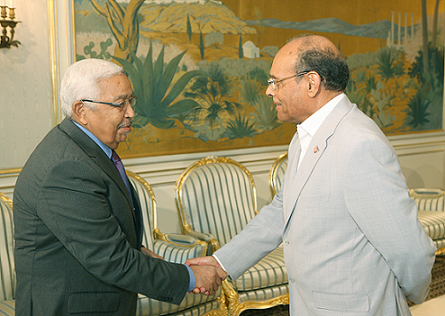
Addis Ababa, 22 August 2013: Former President Pedro Pires of Cape Verde, Special Envoy of the Chairperson of the Commission of the African Union (AU), Dr. Nkosazana Dlamini-Zuma, concluded today his four-day visit to Tunisia as part of a solidarity and consultation mission.
President Pires, who arrived in Tunis on 19 August 2013, has held extensive consultations with the highest Tunisian authorities and other political and social stakeholders. The discussions focused on the political situation, the efforts to complete the transition, and the security challenges facing Tunisia. The discussions also covered regional issues of common interest.
The Special Envoy was received by the Acting President Moncef Marzouki and the Prime Minister and Head of Government, Ali Larayedh. He also met with the Ministers in charge of Foreign Affairs, Othman Jerandi; Justice, Naadhir Benammou; Interior, Lotfi Ben Jeddou; and Human Rights and Transitional Justice, Samir Dilou. He held discussions with the President of the National Constituent Assembly (NCA), Mustapha Ben Jaafar. He also held talks with officials of the following political parties: Rached Gannouchi, President of the Ennahdha Party; Rafaa Ben Achour, a member of the Political Bureau of Nida Tounes, on behalf of its President; and Jribi and Nejib Chebbi, Secretary-General and President of the Political Bureau of the Republican Party, respectively. The Special Envoy also met with the Secretary-General of the General Union of Tunisian Workers (UGTT), Houssine Abbassi, who briefed him on the UGTT’s efforts to facilitate an agreement among the Tunisian stakeholders on how best to overcome the challenges facing the Tunisian transition.
To all his interlocutors, the Special Envoy reiterated the AU’s full solidarity with Tunisia and its people following the assassinations of political figures and terrorist attacks committed in some parts of the country by criminal elements seeking in vain to derail the transition. He assured the Tunisian stakeholders of the AU’s continued support to the transition and its earnest desire to see the transition successfully conclude as soon as possible, through the finalization and adoption of the Constitution and the holding of elections. He stressed the need for all Tunisian stakeholders to continue working in a spirit of compromise and consensus, and to place the interests of Tunisia above all other considerations, adding that this is the most appropriate approach to consolidate the notable progress made to date, to overcome the challenges facing the transition and fulfill the aspirations of the Tunisian people. The Special Envoy emphasized the critical importance, for the entire continent, of the success of the Tunisian democratic transition, which would allow Tunisia to further contribute to the achievement of the AU’s ideals and objectives and bring about an added momentum to democratization in Africa.
The Tunisian authorities and other stakeholders who interacted with the Special Envoy conveyed their appreciation to the AU for having dispatched the mission, and look forward to continued and enhanced support by Africa to the efforts being made by Tunisia, as part of the overall objective to entrench democratic values, the rule of law and respect for human rights on the continent. They affirmed their strong determination to do everything in their power to meet the expectations generated by the January 2011 Revolution. They also emphasized the need for a more sustained regional action in the fight against terrorism and transnational crime.
The Chairperson of the Commission takes this opportunity to thank the Tunisian authorities for the full cooperation extended to her Special Envoy, and reiterates the AU’s commitment to continue working with the Tunisian stakeholders in support of their efforts, including through specific actions to follow up on the outcomes of the mission of the Special Envoy and periodic visits to assess the progress made in the transition and support the on-going process. She urges them to persevere on the path of dialogue and consensus. She appeals to all Member States in a position to do so and to the international community as a whole to provide full support to Tunisia at this important phase of its political development.
Posted by Messay

We use cookies on our website and mobile app to improve content display and overall user experience. The cookies we use do not store personally identifiable information nor can they harm your computer.
We intend to provide you with the right knowledge on-demand at the right time and in the appropriate format to ensure that you engage the African Union constructively in your specific role.
If you have any questions please contact directly PSD web Administrator at shashlm@africa-union.org
COMMENTS
PDF Version
Related Documents
 Press Release: The African Union dispatches a Special Envoy to Tunisia as part of a Solidarity and Consultation Mission [Download ...]
Comminique: Communiqé of the 13th meeting of the panel of the wise of the African Union [Download ...]
Press Release: The African Union dispatches a Special Envoy to Tunisia as part of a Solidarity and Consultation Mission [Download ...]
Comminique: Communiqé of the 13th meeting of the panel of the wise of the African Union [Download ...] Building an African
Narrative Towards
2063