

 comments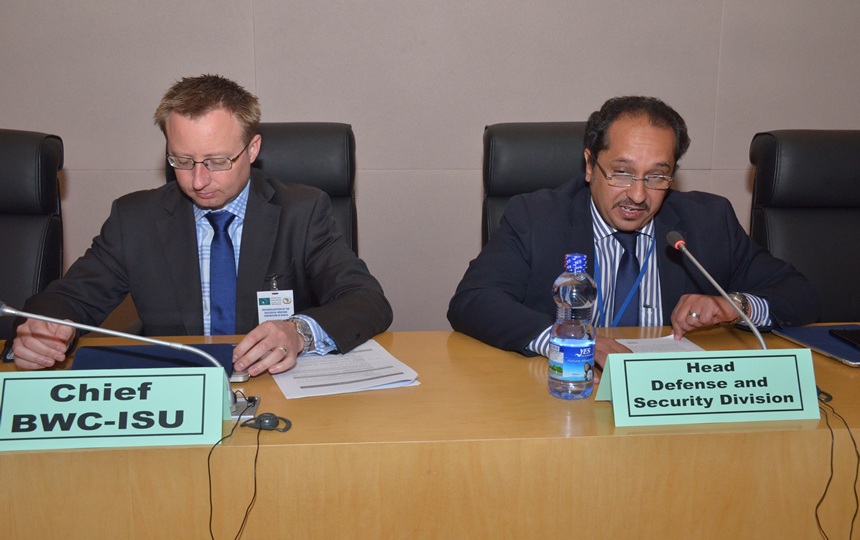
Our distinguished guest and partner, Mr. Daniel Feakes, Chief of the Implementation Support Unit of the Biological Weapons Convention
Excellencies, Ambassadors and Representatives of AU Member States
Distinguished Representatives of the United Nations, Regional Economic Communities, Regional Specialized Agencies and Think Tanks,
Ladies and Gentlemen,
It gives me great pleasure to welcome you, on behalf of the African Union, to this meeting on the Universalization and Implementation of the Biological Weapons Convention in Africa.
At the outset, I wish to thank Mr. Feakes and his team for their collaboration and support extended in organizing this event.
I would also like to extend my thanks to you, all the participants, for your commitment and time and for making the long journey from your respective countries to benefit from and contribute to enriching our deliberations.
Excellencies, Ladies and Gentlemen,
The Common African Defense and Security Policy, adopted by the 2nd Extra Ordinary Summit of the AU in 2004, recognizes that the accumulation, stockpiling, proliferation and manufacturing of nuclear, chemical and biological weapons, and their means of delivery, pose a threat to regional security and call for collective efforts by Member States to address their threat. The Common Defense Policy, therefore, mandates the relevant organs of the African Union to promote and encourage the implementation of the regional and international conventions and treaties on arms control and disarmament. Working within this framework, the African Union has remained strongly committed to the multilateral disarmament and non-proliferation regimes.
The African Union’s role is centered on the principle that universal adherence to the disarmament and non-proliferation regimes will serve to strengthen their effectiveness and authority and provide the required transparency and confidence-building measures. This would consequently ensure that regional and international resources are effectively channeled to enhance international cooperation where all states can equally benefit from the peaceful applications of nuclear, chemical and biological sciences and technology.
This message was reiterated by the Chairperson of the African Union Commission, Her Excellency Dr. Nkosazana Dlamini-Zuma, in her press release of March 2015 in which she commemorated the 40th anniversary of the entry into force of the Biological Weapons Convention. In her message, the Chairperson emphasized that the national measures dictated by the BWC make an important contribution to strengthening public health, particularly in the areas of capacity building, improving bio-safety and bio-security, and enhancing capacities for surveillance of diseases and outbreaks.
Referring to the recent Ebola Virus Disease outbreak, she also stressed the critical need for effective inter-state cooperation under the BWC, emphasizing that in an increasingly interconnected world, such outbreaks pose a threat not only to health but to regional economy and security. The Chairperson has therefore encouraged all AU Member States to ratify and accede to the BWC as early as possible.
Excellencies, Ladies and Gentlemen,
It is in follow-up to the Chairperson’s message that we convene this meeting. This is in fact the first AU-organized event with an exclusive focus on the BWC. As of today, 39 AU Member States are Party to the BWC. However 6 AU Member States are yet to ratify it and an additional 8 remain outside the regime.
Therefore, the objective of the meeting is to enhance understanding among States Parties and Non-parties of the BWC and its implementation. Through experts’ panels and open discussions among all participants, the meeting will aim to offer a clear understanding of what the BWC aims to achieve and how it aims to achieve it. An important segment of this meeting will be dedicated to hearing from the Member States about their national experiences in implementing the BWC and what are the lessons learned that can benefit other States Parties and Non-parties in their future efforts. We will also have the opportunity to discuss international assistance within the framework of the BWC and explore the important role of regional agencies specialized in bio-safety and bio-security in contributing to national and regional efforts.
Excellencies, Ladies and Gentlemen,
This initiative complements AU efforts in the area of disarmament and non-proliferation. I wish to refer to the 2002 decision adopted by the Assembly of the Organization of African Unity in support of the Universalization of the Chemical Weapons Convention. Since then we have been working with the Organization for the Prohibition of Chemical Weapons in assisting States Parties meet their obligations under the Convention as well as benefit from the peaceful use of chemistry for industrial and socio-economic development.
The AU has also taken the lead in advancing the implementation of the African Nuclear Weapon Free Zone Treaty, also known as the Treaty of Pelindaba. In this regard the AU Commission is working towards the timely and effective operationalization of the African Commission on Nuclear Energy.
Moreover, in 2013, the AU Summit adopted a decision requesting the AU Commission to take all necessary steps to support Member States in their efforts in the implementation of the United Nations Security Council resolution 1540 of 2004. The AU has since been working in close collaboration with the 1540 Committee and the UN Office for Disarmament Affairs and has undertaken some important initiatives. This includes the organization of sensitization workshops and trainings for the national points of contact designated by Member States pursuant to the resolution. The AU is also working closely with the 1540 Committee and the relevant regional and international partners towards organizing an Assistance Conference in early 2016.
Excellencies, Ladies and Gentlemen,
In concluding, I wish to thank you all once again for being here, and encourage you to take advantage of this forum to ask questions and share your views and experience. I wish you all fruitful deliberations.
Thank you for your kind attention.
Posted by Lulit Kebede
Last updated by Abraham Kebede

We use cookies on our website and mobile app to improve content display and overall user experience. The cookies we use do not store personally identifiable information nor can they harm your computer.
We intend to provide you with the right knowledge on-demand at the right time and in the appropriate format to ensure that you engage the African Union constructively in your specific role.
If you have any questions please contact directly PSD web Administrator at shashlm@africa-union.org
COMMENTS
PDF Version
 Statement by Dr Tarek A. Sharif – Head, DSD: Universalization of the Biological Weapons Convention in Africa [Download ...]
Related Documents
Statement by Mr Daniel Feakes - Chief of the Implementation Support Branch of the Biological Weapons Convention (BWC) at a Meeting on Universalization of the Biological Weapons Convention in Africa [Download ...] 

Building an African
Narrative Towards
2063